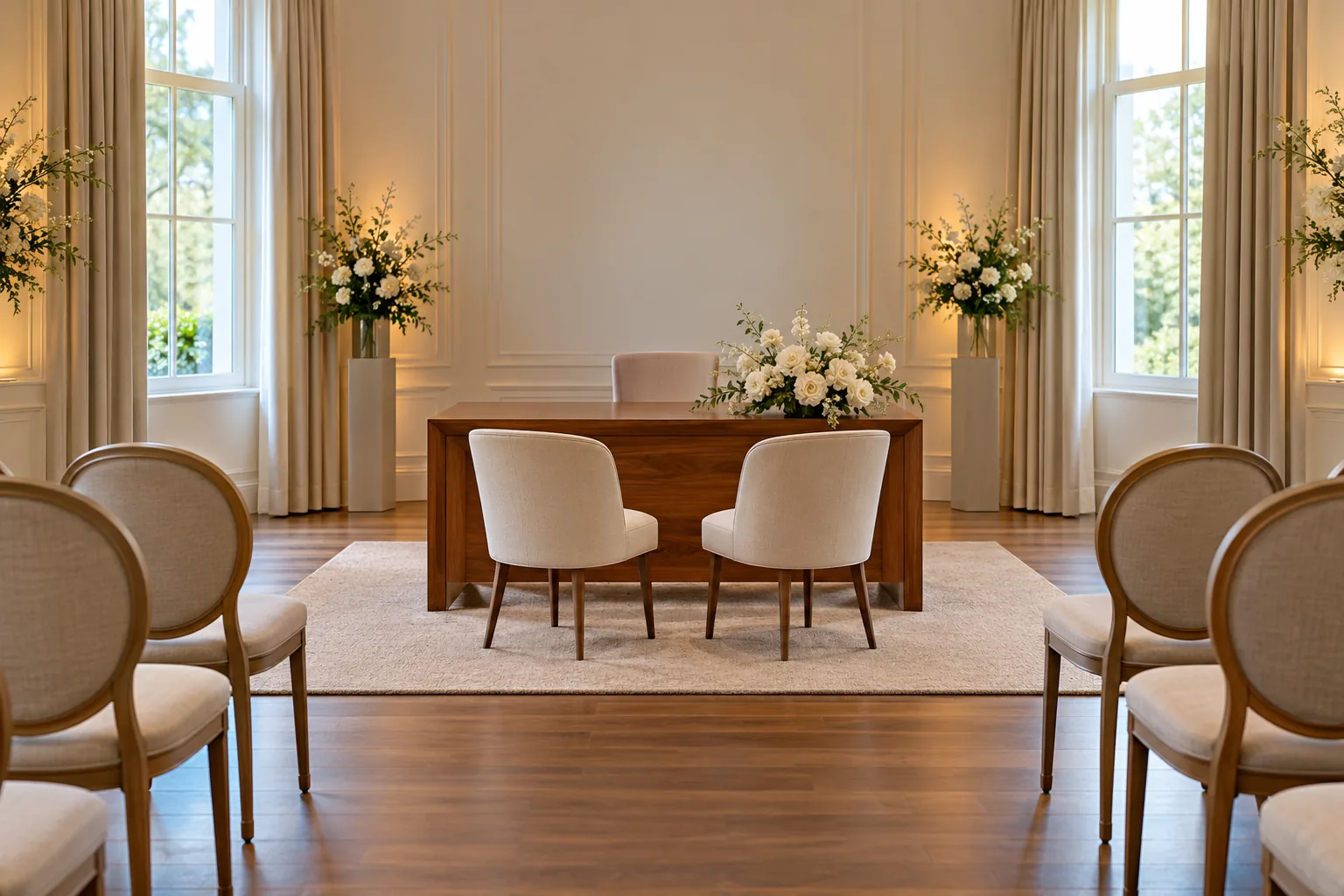
Start by naming the ceremony and the person or body responsible for it: a parish, a church council, a registration office, a celebrant or a community's own elders. That authority, not our photographer, decides where cameras may go. Once you have their instructions, brief us in writing and ask us to show a complete gallery from a comparable wedding.
A church wedding, a civil registration and a community's own wedding customs share one feature that matters to photography: each has a host who decides how the ceremony is run. The couple commissions the photographs, but the host sets the conditions under which they are taken.
This page is the starting point for the church, civil, intercultural and adat ceremonies in this section. General wedding logistics, such as moving between venues, are covered in coordinating wedding ceremony photography, and the wider choices about coverage are in choosing wedding photography coverage.
Who is the ceremony authority?
The authority is whoever is responsible for the ceremony itself, and it differs by ceremony. For a church wedding it is usually the priest or pastor and the church's own coordinator. For a civil marriage it is the registration office or the officer conducting the ceremony. For a wedding led by a celebrant, it is the celebrant together with the venue. For a community-specific wedding, it is the family hosts and the elders who guide the customs.
In Malaysia, civil marriages for non-Muslim couples are registered by the National Registration Department, as set out on the government's family institution portal. Muslim marriages follow a separate process under the state religious authorities. This section does not cover those, and a different cluster deals with them.
What does each ceremony authority usually decide?
Each church, office or community sets its own arrangements, and these differ between places and change over time. So we take them from the responsible person. The questions to ask are similar every time.
| Question | Why it matters to our photographer |
|---|---|
| Where may our photographer stand or move? | Affects lens choice and our positions |
| Is flash or video lighting allowed? | Changes how our photographer works in dim interiors |
| Are there moments when no photography is allowed? | Sets the must-have list around those moments |
| Who may enter the area behind the front pews or the registration desk? | Affects whether guests and photographers share space |
| Is there a separate time for photographs afterwards? | Decides whether portraits happen inside or elsewhere |
| Who gives final instructions on the day? | Gives our team one person to ask |
Write the answers into the brief, with the name of the person who gave them and the date. Our venue photography checklist holds these questions in one place.
How do the pages in this section divide?
The section is organised by the decision you are making.
- Church weddings: the Catholic brief, the Protestant brief and related pages on music, child attendants and portraits afterwards.
- Civil registration: the civil marriage-registration brief and the office ceremony, plus variations such as a short registration followed by a family celebration.
- Interfaith, intercultural and secular ceremonies, where two sets of customs or no religious host are involved.
- Community-specific weddings, where elders and hosts guide what is photographed and how customs are described.
What kind of experience should our photographer have?
Experience in the room matters, but it is only part of the answer. Even experienced coverage still needs the host's instructions, because each parish, office or community runs its own arrangements.
Ask us for three things. These are a complete gallery from a comparable wedding, the name of the person who will photograph yours, and how they prepare for a ceremony they have not covered before. Our guide to how to judge a complete event gallery explains what to look for. When we prepare a quotation, we state the crew and deliverables in writing, so you can compare what is promised with what you have seen.
What decisions belong to the couple and families?
Your hosts decide what is permitted. You decide what you want. The practical work is bringing the two together before the day, so nobody negotiates in front of guests.
The decisions that usually belong to you include:
- Which moments matter most, in order of priority.
- Who must appear in group photographs, and who should be left out.
- Whether photographs of children or elders may be shared beyond the family.
- Who is the single contact for our team on the day.
- What happens to the photographs afterwards, and who approves publication.
For the last point, see our guide to permission to photograph and permission to publish.
A hypothetical example
For example, imagine a couple who hold a short civil registration on a Friday morning, a church blessing the next day and a family dinner that evening. They have three hosts: the registration office, the church coordinator and a restaurant. They send each host the same short question list, record the answers, and give our photographer one page per event. Our team plans a light, quiet approach for the registration, positions for the church based on the coordinator's reply, and a looser style at dinner.
Nothing in this example assumes a fixed ceremony. It shows how three different sets of instructions become one plan.
How does this affect cost and deliverables?
Several short ceremonies in different places usually take more planning and travel than one long block. Restricted movement can also change whether a second photographer is useful, and we confirm if one is available for your date. Our coverage hours planner and multi-event commission organiser help you set out the timeline. The guide to event photography prices and quotation planning explains the factors behind a quotation without quoting figures.
What should you prepare before contacting our photographer?
Gather the ceremony name, date, venue, the person responsible, the contact details of the coordinator and any written guidelines the church or office has provided. If a community's elders are advising, record their names and what they have asked for.
Then send a short note with the programme and your priorities. We will propose coverage, ask what is missing, and confirm the date, venue, crew and deliverables in writing. Where a ceremony's customs are unfamiliar to us, we ask your hosts to explain them before the day instead of assuming.
Checklist
- Name each ceremony in your wedding and the person or body responsible for it.
- Ask that person for photography instructions in writing.
- Ask the venue whether it has separate rules for cameras, flash and movement.
- List who must be photographed and who prefers not to be.
- Request a complete gallery from a wedding with a similar structure.
- Confirm the date, crew and deliverables in a written quotation.
Tell us the ceremony, the venue and who is responsible for it. We will propose coverage that works inside their instructions, then confirm the date, crew and deliverables in writing.
Ask about your ceremonyExplore: Church, civil and adat weddings
33 pages- Catholic wedding photography brief
- Photography for a Catholic wedding with Mass
- Photography for a Catholic wedding without Mass
- Protestant church wedding photography brief
- Anglican wedding photography requests
- Orthodox Christian wedding photography requests
- Wedding choir and church-musician photographs
- Church wedding photographs with child attendants
- Church wedding portraits after the service
- Can a photographer attend your marriage registration?
- Photography at a registration-office ceremony
- Civil registration at an approved outside venue
- Photos for a short civil registration
- Small civil registration photos with a few witnesses
- Civil registration and religious ceremony on one day
- Family celebration after a private registration ceremony
- Signing photos that keep your IC details private
- Wedding blessing photos after registering
- Church vow renewal photography
- Interfaith wedding photography brief
- Mixed-culture wedding photos with both families' traditions
- Secular celebrant wedding photography
- Photographing separate faith ceremonies on different days
- Iban wedding photography
- Bidayuh wedding photography
- Kadazan-Dusun wedding photography
- Murut wedding photography
- Orang Ulu wedding photography
- Wedding photography in a longhouse setting
- Adat wedding photographs alongside a church ceremony
- Ask an elder to check your adat photo plan
- Photos of traditional wedding attire and heirlooms
- Sharing wedding photos with your community hosts
Common questions
Who decides whether your photographer can move around during the ceremony?
The person or body responsible for the ceremony decides, and this may be a priest, pastor, church coordinator, registrar, celebrant or community elder. Venues can add their own rules. Our photographer works within their instructions. Ask the responsible person for written instructions and pass them on before the day.
Do you need to have photographed our exact denomination or tradition before?
Prior experience helps, but it is not a substitute for the host's instructions. Ask to see a complete wedding with a similar structure, and ask how our photographer prepares for a ceremony they have not covered. We confirm what our team can cover for your ceremony before anything is booked.
Can we use the same brief for a church ceremony and a civil registration?
Not safely. The two have different hosts, different attendance and different rules about cameras. Write one short brief for each, using the details the church or the registration office gives you, and let our team plan the day around both.
What if the community's customs are new to your photographer?
Then the family and the community elders lead. Ask your hosts what may be photographed, what should not be and who can explain the meaning of attire and objects. We ask these questions early rather than guess or invent a sequence.
Sources checked
Ask about your ceremony
Tell us the ceremony, the venue and who is responsible for it. We will propose coverage that works inside their instructions, then confirm the date, crew and deliverables in writing.
What happens next: You send your event details on WhatsApp. Our team reads the brief, asks what is missing, then confirms in writing whether the date, venue and coverage can be booked, with a quotation. Opening WhatsApp does not send anything, and a message is not a booking until both sides confirm.
Last reviewed: