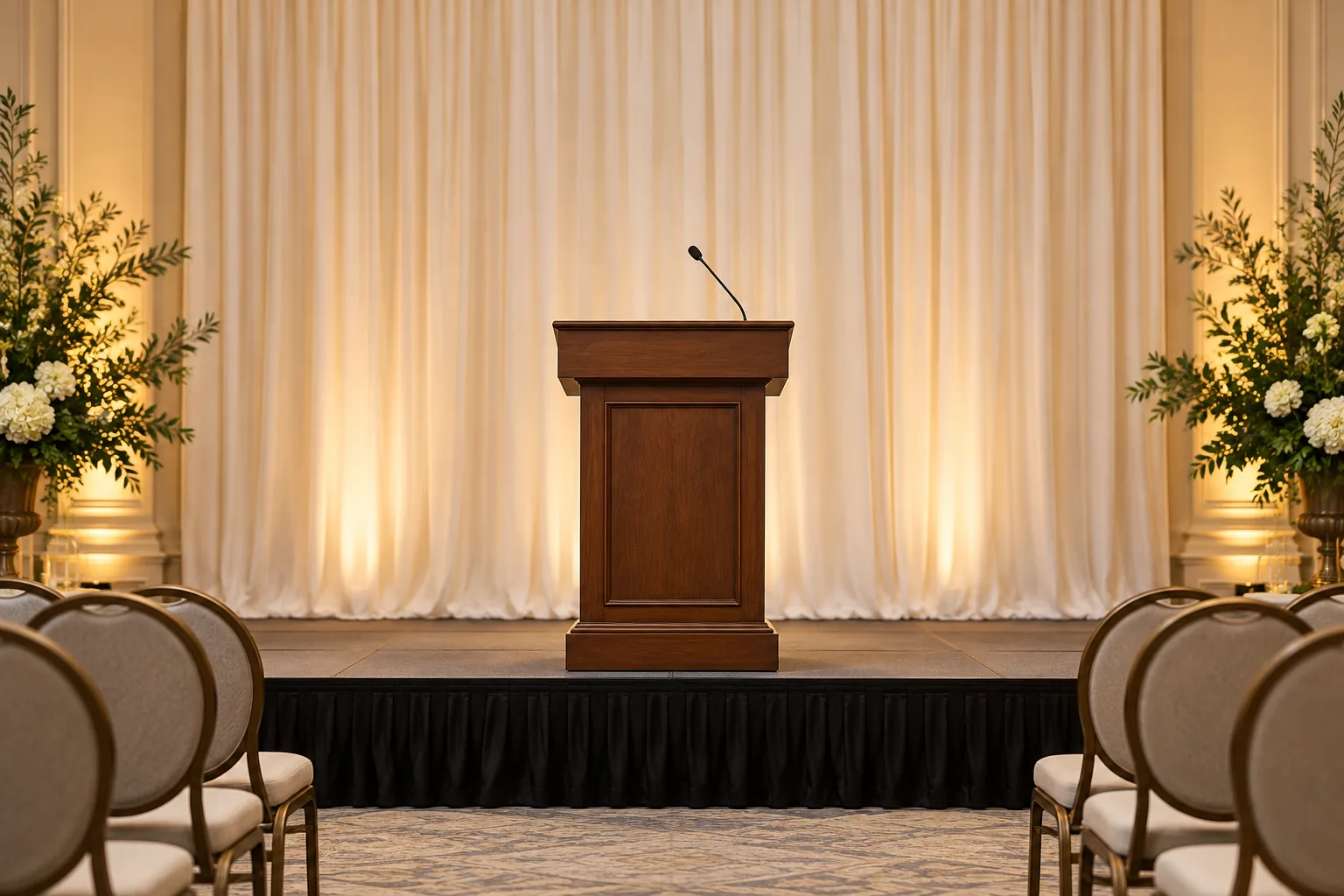
Photography for an official occasion is commissioned through the institution's authorised contact, not agreed between our photographer and individual guests. The institution decides who may enter, where the camera may stand and what may be released. A good brief states the real programme, the approved access and the record the institution wants, and we confirm what we can deliver in writing.
Official and public-institution events have a different shape from a company dinner or a wedding. The programme is formal. Some people are present because of their office, not as private guests. Protocol decides who stands where, and the institution decides what the public may see afterwards.
This page is the overview for our work in this area. It links to the specific occasions: openings, arrivals, signings, visits, commemorations, awards and more.
Who commissions an official event photographer?
The commissioner is the institution, acting through a person with authority to do so. That is often a secretariat, a protocol office or a communications unit. Guests, their aides and other agencies may all have views, but they are not the client.
Say early who signs the quotation, who gives day-of instructions and who approves release. If these are three different people, write all three names down. Our guide to agreeing photography priorities with several decision-makers helps when the answers differ.
What do we need from the institution?
We work from facts the institution gives us. Accreditation, security access and knowledge of how a particular office runs its events come from the office itself.
- The real programme, with timings and venue.
- The formal participants, their names and titles as they should appear.
- The access our photographer has been cleared for, and any pass or vetting steps.
- Areas and moments where photography is limited or not allowed.
- The approval route for captions and release.
The event photography brief builder turns these into one document you can share with colleagues.
How does protocol shape the coverage?
Protocol offices set the order of arrival, seating, greeting and positioning. If our team guesses the order, the resulting image may imply the wrong precedence. We take the sequence from the protocol contact, and the greeting order and ranking follow it. Our pages on VIP arrivals and formal greetings and formal group photographs with institution-approved positioning show how that works in practice.
Which occasions does this cover?
| Occasion | Our page |
|---|---|
| Opening of a facility or programme | Official-opening photography |
| Signing of an agreement | Official signing-ceremony photography |
| Visit to a site | Official site-visit photography |
| Memorials and civic ceremonies | Official commemorations and civic ceremonies |
| Awards and recognition | Institutional awards and formal recognition |
| Restricted or controlled events | Restricted areas or controlled publication |
Private commercial openings belong in our commercial opening guidance, not here.
What is an accurate record?
The aim is a record that shows what happened, to the people who were there, in the roles they held. Accuracy depends on three things: verified names and titles, captions that describe the event without adding claims, and release only through the approved route. Our guide to accurate names and titles in official-event captions covers the first.
A photograph shows attendance. It does not prove that a decision was taken, an appointment became effective or a guest agrees with a policy. Captions should not suggest otherwise.
Law, contract, venue rules and house policy
These four layers are easy to confuse.
- Law. The Personal Data Protection Department explains that the Personal Data Protection Act 2010 applies to personal data processed in commercial transactions. Whether and how it applies to a public body is a question for the institution's legal adviser.
- Contract. Our written quotation sets who may use the images and for what. MyIPO states that copyright protection arises automatically when a work is created, so ownership and licence terms matter. See copyright ownership and permission to use event photographs.
- Venue rules. The venue or site owner may limit photography.
- Institutional policy. Rules on who may release images are the institution's own choice.
Typical deliverables and cost drivers
Deliverables vary: a small press set for quick release, a fuller archive set, or both. The image-use and approval register keeps track of what each set may be used for. Cost depends on coverage hours, crew size, number of locations, delivery speed and image-use terms. We confirm all of this in the quotation. For general pricing principles see event photography prices and quotation planning.
How we plan and confirm
We read your brief, ask what is missing and propose coverage. We confirm the date, venue, crew, deliverables and approval route in writing before the event. If a requirement depends on a decision we have yet to receive, we say so and ask for it. Our photography responsibility planner helps you record who owns each decision.
Questions to prepare
- Who is the single point of contact on the day?
- Which moments must not be photographed?
- Which images go to media, and who releases them?
- Are there foreign or visiting guests whose release is handled by another office?
- What happens if the programme changes at short notice? See late protocol changes during an official event.
What a first conversation looks like
A useful first message is short. It names the institution, the date and venue, and the type of occasion. It says who the authorised contact is and whether the programme is final. It lists any hard limits, such as a closed rehearsal, a restricted room or a ban on certain guests being photographed.
We reply with questions first. Typical questions are: how many formal moments need a named participant, how many rooms are in use, and whether media photographers are already allowed in. From the answers we propose coverage, say what is still unknown and put the plan in writing.
When the occasion is shared between institutions
Some official events are hosted by more than one body. Each may have its own protocol officer, and their instructions can differ. Agree which office has the final word on positions and release before the day. Our page on official events co-hosted by several institutions goes into this in more detail.
When you are ready, message us the institution, the date and the venue. We will start the written plan from there and tell you what still needs the institution's decision.
Checklist
- Name the authorised contact who commissions and approves the record.
- Attach the real programme with timings, venue and formal participants.
- Confirm in writing which areas our photographer is cleared to enter.
- List areas or moments where photography is limited or prohibited.
- Agree who approves captions, names and titles.
- Decide which images go to media and which stay in the archive.
Send us the programme, the name of your protocol or communications contact and the approvals needed for release. We will tell you what we can confirm for your date and what needs the institution's decision first.
Request a proposalExplore: Official and institutional occasions
30 pages- Official opening ceremony photography
- VIP arrivals and formal greetings
- Official signing ceremony photography
- Official site visit photography
- Photographing foreign delegations at official events
- Groundbreaking and topping-out ceremony photos
- Memorial and civic ceremony photography
- Award ceremony photography for institutions
- Official event photos with restricted areas
- Getting names and titles right in event captions
- Photography when only a media pool is allowed
- Formal group photos arranged by your protocol office
- Official handovers and leadership appointment ceremonies
- Public-policy announcement events
- Public consultation event photography
- Official events where photography may not be allowed
- Photos during official inspection visits
- Photographing official emblems, flags and backdrops
- Official events co-hosted by several institutions
- State banquets and formal institutional receptions
- Public-agency anniversary events
- Public-facility handover ceremonies
- Uniformed service open day photography
- Photos for emergency service award events
- Embassy and diplomatic reception photography
- Civic parade photography for organisers
- Press picks and full event photo sets
- Official signings when some parties are absent
- Our experience with official events
- Last-minute protocol changes at official events
Common questions
Who should contact your photographer for an official event?
The person authorised to commission the record, usually from the secretariat, protocol office or communications unit. A guest's aide may pass on wishes, but the instructions that bind the photography come from the institution. Name that contact in the brief and say who else may change it.
Can your photographer arrange access or accreditation?
Access and any accreditation are granted by the institution or the venue authority. We work with the passes and clearances you obtain, and we confirm in writing which ones are in place for our team. If entry needs vetting or a pass list, send the requirement early so the institution can process it.
Do you have experience of official events?
Tell us the type of occasion and we say in writing what relevant examples we can show before you commit. Examples are shared only with client permission, so no institution's private work is exposed.
What if the programme is confidential until the day?
Share what you can through the authorised contact. We can plan around timings and positions without knowing the content of speeches or documents. Sensitive detail stays with the institution, and we ask only for what the coverage needs.
Who approves the photographs for release?
The institution decides, through a named approver. Agree beforehand whether images go to media, to leadership first or only into an internal archive. Our written plan records who approves each set and in what order.
Sources checked
Request a proposal
Send us the programme, the name of your protocol or communications contact and the approvals needed for release. We will tell you what we can confirm for your date and what needs the institution's decision first.
What happens next: You send your event details on WhatsApp. Our team reads the brief, asks what is missing, then confirms in writing whether the date, venue and coverage can be booked, with a quotation. Opening WhatsApp does not send anything, and a message is not a booking until both sides confirm.
Last reviewed: